AI Orchestrator for Decision-Making
2026-01-15
Why a single powerful AI is not enough for hard decisions, and how an orchestrator that forces structured disagreement can surface real trade-offs and improve judgment.
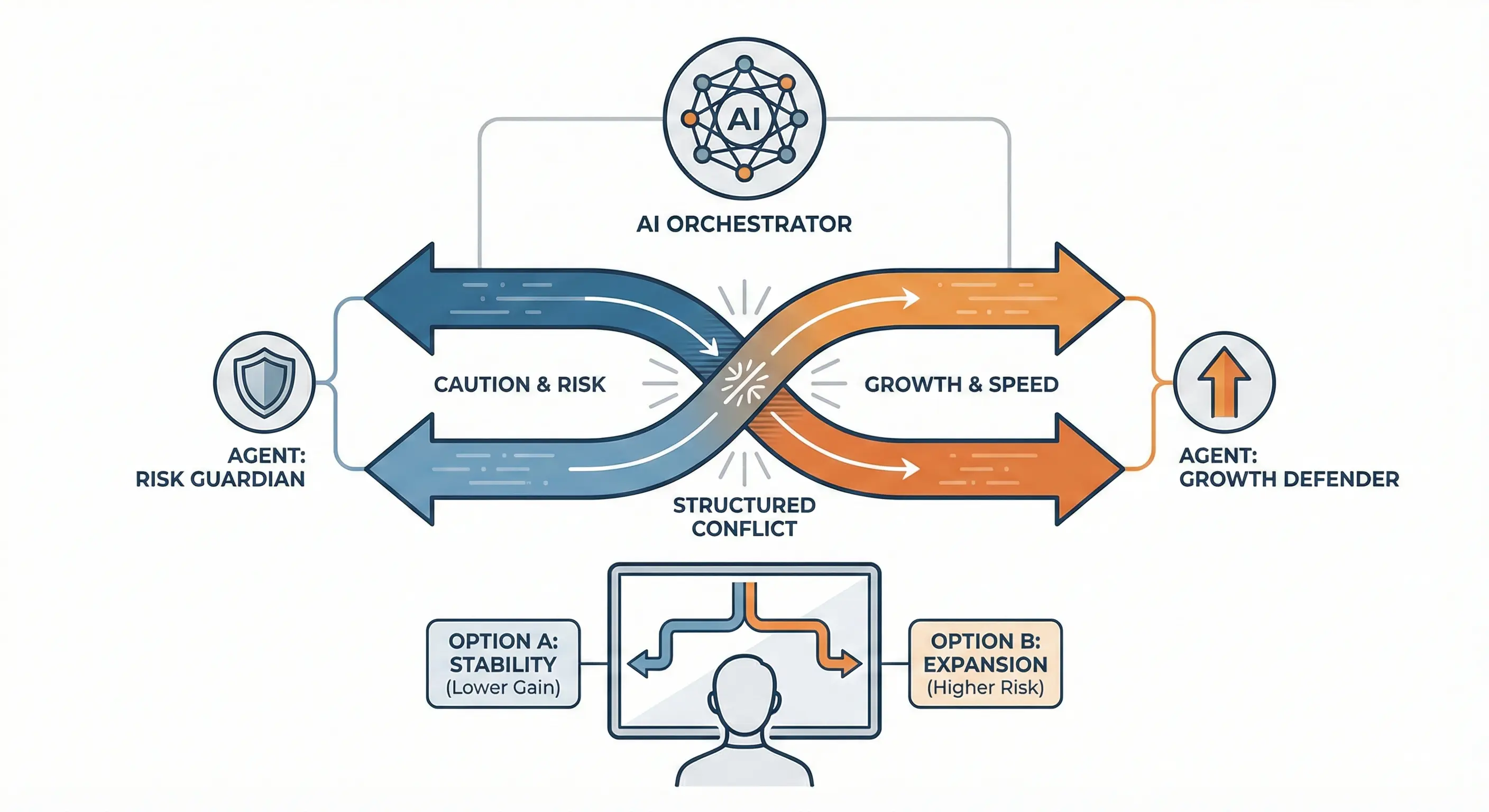


Designing an AI Orchestrator for Decision-Making Under Conflict
Most AI applications today are built to remove friction.
They summarize, automate, optimize, and decide faster than humans ever could.
This works extremely well for execution-heavy tasks — but it quietly breaks down when the problem is not execution, but judgment.
This article explores a different idea:
an AI orchestrator designed not to give answers, but to expose conflict, surface trade-offs, and help humans understand why a decision is difficult before choosing.
The problem with “smart answers”
When we ask a powerful AI for advice, we usually get something that feels:
- reasonable
- balanced
- coherent
- well-structured
And yet, for important decisions, that clarity can be misleading.
Why?
Because most hard decisions are not hard due to lack of information, but due to:
- conflicting incentives
- incompatible values
- asymmetric risks
- uncertainty about what really matters
A single AI model, no matter how capable, tends to resolve these conflicts internally before presenting an answer.
The user only sees the polished result, not the tension that produced it.
In practice, this means:
- trade-offs get softened
- risks get averaged out
- uncomfortable perspectives disappear
The decision looks easier than it actually is.
A different approach: externalizing conflict
Instead of asking one AI to “think harder”, we can change the architecture of the thinking itself.
The key idea is simple:
If a decision is hard because experts would disagree,
then the system should force that disagreement to happen explicitly.
This is where the AI orchestrator comes in.
Rather than acting as an advisor, the orchestrator acts as a designer of cognitive conflict.
What an AI orchestrator really is
An AI orchestrator is a coordinating intelligence whose job is not to reason about the decision directly, but to:
- detect where the real conflict lies
- decide which perspectives matter
- force those perspectives to clash
- preserve disagreement long enough for insights to emerge
Crucially, the orchestrator does not participate in the debate.
It does not argue.
It does not persuade.
It does not choose.
It designs the conditions under which disagreement becomes informative.
Why not just ask one AI for multiple perspectives?
This is the obvious question.
In theory, a single powerful AI can:
- list pros and cons
- simulate different viewpoints
- role-play multiple experts
In practice, it still suffers from one structural limitation:
All viewpoints collapse into a single internal reasoning process.
This means:
- contradictions are resolved too early
- incentives are harmonized
- extreme or unpopular positions get diluted
The result is a “reasonable” answer — but not an honest representation of conflict.
An orchestrator system avoids this by:
- separating perspectives into independent agents
- giving each agent a persistent role
- preventing premature consensus
Conflict stays visible.
The role of agents
Agents are not generic personalities or historical characters.
Each agent represents:
- a legitimate worldview
- a specific incentive
- a way the decision could fail
Examples of agent roles:
- a financially conservative operator
- an aggressive growth advocate
- a technical pragmatist
- a legal or reputational risk guardian
- a user-centric skeptic
The purpose of agents is not creativity.
It is friction.
Step-by-step system flow
1. The user frames a dilemma
The user does not ask for instructions.
Instead, they describe:
- the situation
- the constraints
- the available options (if known)
- what makes the decision uncomfortable
This reframes the interaction from “tell me what to do” to
“help me understand what is really at stake”.
2. The orchestrator detects the conflict
Before any debate happens, the orchestrator analyzes the input and asks:
- Is this a strategic decision or an execution task?
- Is the decision reversible or irreversible?
- Where is the real trade-off?
- What values are in tension?
Typical conflict axes include:
- growth vs stability
- speed vs quality
- short-term wins vs long-term resilience
- simplicity vs scalability
- cost vs risk
If no meaningful conflict exists, the orchestrator should refuse to orchestrate.
Not every problem deserves this level of friction.
3. Selecting the right agents
Not all perspectives are relevant to every decision.
The orchestrator selects agents that:
- genuinely disagree
- have incompatible priorities
- would argue past each other in real life
This step is critical.
Bad agent selection leads to shallow debate.
4. Structured disagreement
The debate is intentionally constrained.
Common rules include:
- agents must defend their position even when challenged
- agents must explicitly name risks and sacrifices
- agents cannot converge too quickly
- agents must attack assumptions, not personalities
The goal is not resolution.
The goal is exposure.
5. Extracting decision clarity
The final output is not a transcript.
Instead, the orchestrator synthesizes:
- where disagreement truly lies
- which option wins under which values
- which risk dominates the decision
- which assumption is most fragile
- what the user is likely underestimating
This transforms raw debate into something actionable without deciding for the user.
When this pattern works best
An AI orchestrator is useful when:
- the cost of being wrong is high
- the decision is hard to reverse
- experts would genuinely disagree
- understanding trade-offs matters more than speed
Typical use cases include:
- pricing strategy
- key hires
- product pivots
- market entry decisions
- risky automation
- ethical or reputational trade-offs
When it should not be used
This pattern should not be applied to:
- routine execution
- content generation
- optimization problems with clear metrics
- low-risk or reversible decisions
- problems with a single correct answer
In those cases, orchestration adds unnecessary noise.
The deeper insight
The orchestrator does not make decisions better by being smarter.
It makes decisions better by making conflict explicit.
Most bad decisions are not made because people lack information,
but because they do not fully see what they are sacrificing.
This system exists to make those sacrifices visible.
Final thought
An AI orchestrator like this is not a product by default.
It is a design pattern.
A way to embed:
- structured disagreement
- cognitive friction
- and clarity under uncertainty
into systems that deal with ambiguity.
Used correctly, it does not replace human judgment.
It strengthens it.
Which AI helped me write this article?
Yes, I use AI to help me create quality content. Can you guess which one?